From sugarbeet to GRUM
Today, we associate the sugar beet primarily with sugar. However, few know that the road to modern beet spirits began more than four centuries ago. From the discovery of sugar in beets, through Napoleon's promotion of beet cultivation and the rise of the Tienen sugar industry, to the development of alcohol from beet molasses: each chapter brought us closer to what is possible today. This timeline tells the remarkable story of a humble root that grew into the foundation of GRUM.
Can sugar dominates
Up until the 18th century, cane sugar dominated the sugar market. In Europe, sugars were imported from overseas territories. In Belgium, initially via Bruges and subsequently Antwerp.
Beets as a source of sugar
Olivier de Serres discovered as early as the 16th century that sugar could be extracted from sugar beets. Despite his discovery, cane sugar production remained dominant and was not given further attention.
Continental trade blockade
Two years after his last visit to Tienen, Napoleon issued the Continental Blockade. This hampered the import of sugarcane via Great Britain. The discovery of Olivier de Rennes came back into the picture.
Napoleon mandated sugar beet cultivation
At the time of the Blockade, few sugar beets were grown on French territory. Napoleon therefore began making cultivation compulsory. Farmers were initially reluctant to grow sugar beets. They feared that the crop would deplete the soil.
Sugar factories in Tienen
After the fall of Napoleon in 1815, sugarcane once again entered the ports in massive quantities. However, the Belgian government was convinced of the benefits of sugar beet cultivation. To persuade farmers and industrialists, a fiscally favorable regime was introduced for beet sugar. The Tienen sugar factories were established, and the beet sugar industry experienced rapid growth.
The station and "the iron road"
The construction of the Leuven-Tienen railway line and the establishment of the sugar factory created a mutual stimulus. This process, known as the “Belgian virtuous circle,” illustrates how railways and industry reinforced each other in the 19th and early 20th centuries. Today, Tienen station is the oldest on the European mainland.
Savalle and Corenwinder
The invention of column distillation by Desiré Savalle made it possible to distill pure alcohol from beet molasses. Benjamin Corenwinder optimized the fermentation and distillation process for this. This invention also subsequently gave rise to the Spanish style (light rum) within rum production.
H.H. COUSINS & RAFAËL ARROYO
The Jamaican chemist H.H. Cousins patented the process for making aromatic rum from cane molasses in 1906. He introduced the reuse of pure or tainted vinasse and the use of acids. Between 1938 and 1944, the Jamaican Rafael Arroyo published his scientific approach to rum production. He developed new fermentation techniques that significantly improved rum production. His work focused on optimizing fermentation processes.
Aromatic spirits from beet molasses
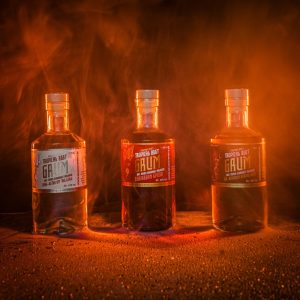
Until a few years ago, sugar beet molasses was considered inferior and used only to sweeten animal feed or to produce neutral alcohol. With the COVID-19 crisis, it became relevant again to think differently. Distillers worldwide began searching for an alternative to rum made from sugar beet molasses. By studying the work of HH Cousins and Rafaël Arroyo, and by pre-treating beet molasses before fermenting and distilling, we arrived at Belroot Spirits, the first aromatic hi-ester spirit from beet molasses, in which every earthy taste was neutralized. A new chapter in the distillation of sugar beet molasses!
